


Last updated: October 7, 2026
Every incision made during gynecomastia surgery leaves a permanent scar, although the mark may become less noticeable as it heals. If you are considering gynecomastia surgery and concerned about scars, the practical question is where an incision can be placed while still treating the gland tissue, chest fat, and loose skin that affect the final contour. At Boston Gyno, our male breast reduction surgery plan starts with that balance, not a promise of invisible scars.
Does gynecomastia surgery leave visible scars?
Whether a scar is conspicuous depends on its length and location and on individual healing. A small puncture may leave a small mark, while gland removal or skin reduction may require an incision along the areola or chest fold.
What does a breast surgery scar look like?
A healed scar may be lighter or darker than the surrounding skin, and some scars become raised. The American Society of Plastic Surgeons’ page on gynecomastia surgery results explains that incision lines may be concealed within natural contours, but some remain visible.
Can gynecomastia surgery scars disappear completely?
No. A scar may fade or blend into a natural chest contour, but the incision line remains permanent.
Where are incisions placed for gynecomastia surgery?
Gynecomastia incision placement depends on what must be removed and how much skin must contract afterward. A small access puncture may suit selected patients, while more gland tissue or excess skin can call for an areolar or chest-fold incision. The least visible incision is useful only if the approach can adequately reshape the chest.
When can a small lateral puncture be used?
We consider a small lateral puncture when an examination suggests we can adequately reshape your chest without an areolar or chest-fold incision. Its location avoids those incision sites, but the puncture still leaves a permanent mark.
When might an areolar or chest-fold incision be needed?
An incision near the areolar border can provide access for gland excision. Removing substantial loose skin may require a longer incision along the lower chest contour. An article on the American Society of Plastic Surgeons’ site about gynecomastia surgery notes that skin removal can leave a more visible scar even when the incision follows the pectoral line.
The choice also depends on whether fullness is mainly fat or includes firm gland tissue. Our guide to gland excision surgery for gynecomastia explains why that distinction matters. For a comparison focused on fatty fullness, see this educational discussion of liposuction versus excision for gynecomastia.
How does gynecomastia severity affect the scar plan?
Greater tissue volume and looser chest skin can make a short-incision approach less suitable, but a severity grade alone cannot predict a scar. Surgical planning weighs how much skin may contract against how much must be removed for a satisfactory contour. Published reviews describe varied approaches rather than a guaranteed grade-based scar outcome.
How does loose chest skin change the surgical approach?
After tissue removal, the remaining skin must settle over the new chest shape. If skin is substantially stretched, preserving all of it may leave sagging even when gland tissue and fat have been reduced. An article on the American Society of Plastic Surgeons’ site about gynecomastia after weight loss describes why redundant skin can require longer incisions and notes that scars may continue improving within a year.
How do skin-sparing and skin-reduction procedures compare?
Skin-sparing surgery limits skin excision and its associated incision length. Skin reduction accepts a longer scar when removing excess skin is needed to improve the contour. The following findings describe surgical practice patterns, not the best operation for every patient:
| Source | Finding | What it means for scar planning |
|---|---|---|
| 2020 review, Surgical Management of Gynecomastia: A Comprehensive Review of the Literature | The literature review included 1,112 surgical patients. Skin-sparing mastectomy with or without liposuction was used most frequently, followed by mastectomy with skin reduction. | Both approaches have a role; frequency of use does not establish an individual’s likely scar. |
| 2024 review, Available Techniques to Minimize Scars in Surgical Management of Gynecomastia | The review found limited evidence for skin-retraction techniques that avoid skin excision and noted that substantial skin redundancy is often treated with skin resection. | A shorter incision may involve a trade-off in how much loose skin can be addressed. |
How does Boston Gyno perform small-puncture male breast reduction?
In appropriate candidates, we reduce enlarged gland tissue through a small puncture at the side of the chest. Liposuction addresses fat and shapes the chest separately. The amount of gland tissue, fat, and loose skin determines whether this approach can adequately treat your chest or whether we should discuss a different incision plan.
How do VASER and power-assisted liposuction shape the chest?
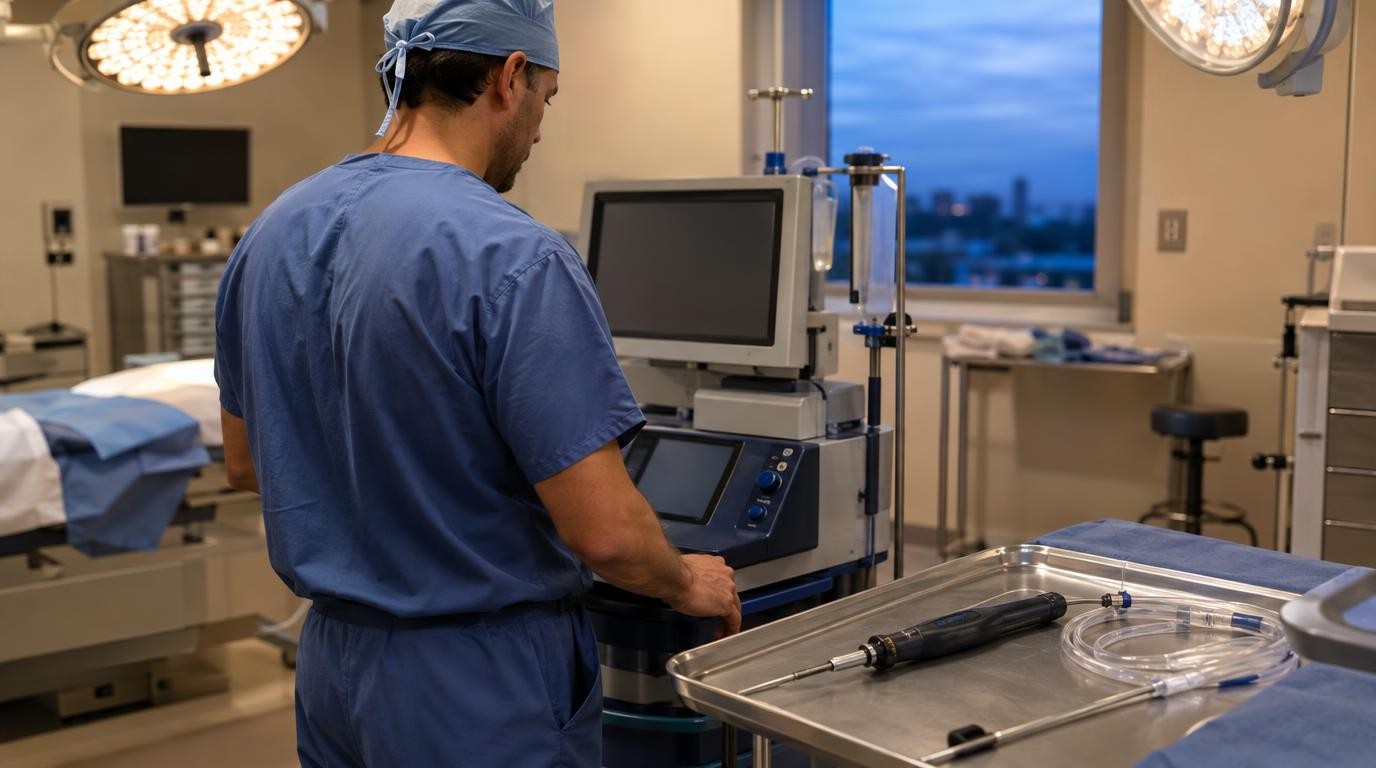
We use VASER Liposelection and power-assisted liposuction to define the side and lower borders of the chest muscle as we treat fatty fullness. Our overview of gynecomastia surgery techniques discusses other ways to address different tissue and skin needs.
Why are port protectors used during liposuction?
We place port protectors at liposuction access points to limit repeated friction against the skin and reduce the chance of a thick scar from a liposuction-related friction burn.
Who may be a candidate for surgery rather than observation?
Adults who have finished puberty and have had persistent gynecomastia for more than a year are unlikely to see it fully reverse with medical treatment alone, according to an article on the American Society of Plastic Surgeons’ site about gynecomastia treatment. Surgery may be an option after the cause is evaluated. Chest fullness can reflect gland tissue, fat, or both, and loose skin also affects incision planning.
What causes gynecomastia?
According to Cleveland Clinic’s overview of gynecomastia, a shift toward more estrogen relative to testosterone often contributes to glandular breast growth. Enlargement caused by excess fat alone, without glandular growth, is called pseudogynecomastia. Puberty and aging are common times for hormonal changes; medicines, substances such as anabolic steroids, and underlying conditions can also contribute. Johns Hopkins Medicine’s guide to gynecomastia notes that sometimes no cause is found.
Is gynecomastia reversible?
Sometimes. Observation may be appropriate when puberty-related enlargement could improve on its own. Treating an underlying condition or working with a prescriber to adjust a contributing medicine may also help. Weight loss can reduce fatty chest fullness, while a clinician may consider medication for selected cases of glandular gynecomastia. Long-standing gland tissue may not fully reverse with nonsurgical treatment.
Do not stop a prescribed medicine on your own because of a suspected connection to breast enlargement.
What happens during treatment and early recovery?
Treatment may combine gland reduction and liposuction, with skin removal if your plan calls for it. After male breast reduction, we monitor recovery and use staged compression garments, ultrasound-assisted massage, and drainage methods as part of postoperative care.

What anesthesia and drainage approaches does Boston Gyno use?
We mainly use local tumescent anesthesia and may add inhaled nitrous oxide for comfort when needed. We typically use a drainless or rubber-band technique instead of a large drain. Bruising, swelling, and temporary firmness can occur during early healing, while a developing fluid or blood collection needs assessment rather than an assumption that it is routine swelling.
The American Society of Plastic Surgeons’ article on gynecomastia surgery says patients treated with liposuction alone typically return to work and exercise in less than one week, while those needing surgical breast-tissue removal may take two to four weeks to heal enough for routine activities. These are general, technique-dependent estimates, not a promised Boston Gyno recovery schedule. Follow your individual instructions before returning to work, exercise, or other activities.
When should patients ask about compression and scar care?
A support garment can help manage swelling and support the chest as it heals. Our gynecomastia compression garment guide explains garment use in more detail.
The American Society of Plastic Surgeons’ recovery guidance explains that a support garment may help manage swelling and that patients should receive specific instructions for incision care and follow-up. Use silicone tape or scar massage only after the incision has healed, not on an open or still-healing wound.
How long do gynecomastia surgery scars take to fade?
Scars may continue fading during the first year, although the incision lines remain permanent. Chest swelling and scar appearance can change on different timelines.
What changes might happen during the first year?
The American Society of Plastic Surgeons notes that a change in chest contour can be visible immediately after surgery, while swelling resolves and final chest results may take 3–6 months. Scars can look red during the first few months and may keep fading after the chest contour settles; the 3–6-month estimate is not a deadline for scar fading.
Which factors can make a scar more noticeable?
Individual healing, skin quality, incision placement, wound tension, and the amount of loose skin all influence appearance. Some people develop raised or thick scars despite careful placement. A longer incision used to remove excess skin may be more visible, but preserving too much skin solely to shorten a scar can compromise the intended contour.
Will a scar tissue lump go away after surgery?
A lump after gynecomastia surgery may soften as healing progresses, but whether a lump goes away depends on its cause. Firm healing tissue, a fluid collection, bleeding beneath the skin, and persistent gland tissue can feel different or overlap. A lump cannot be reliably identified from its appearance or firmness alone.
When should a new or growing lump be assessed?
Contact the surgical team about a new, enlarging, painful, or otherwise concerning lump. Describe when it appeared, whether it is changing, and whether swelling or skin changes accompany it. An examination can establish whether observation is reasonable or whether the lump needs treatment; repeatedly massaging an unexplained lump is not a substitute for assessment.
What are the risks, and who should postpone gynecomastia surgery?
Potential complications include hematoma, seroma, infection, contour irregularity, nipple numbness, loss of nipple skin, and visible or thick scars. A hard, fixed lump outside the nipple area, nipple discharge, skin changes, or enlarged lymph nodes warrant evaluation for possible breast cancer before elective surgery. We may recommend postponing elective surgery until ongoing use of a contributing substance, such as anabolic steroids, has been addressed and your weight has stabilized. If a prescribed medicine may be contributing, plan any changes with its prescriber.
Results are not guaranteed. Another operation may be needed to tighten or reposition the chest or treat a complication. That differs from scar revision, which addresses an unwanted scar and creates a new incision.
The 2020 review of surgical management cited above reported complication rates across varied studies and procedures, not a predicted risk for an individual patient:
| Source | Reported finding | Interpretation |
|---|---|---|
| 2020 Surgical Management of Gynecomastia literature review | Major complication rates ranged from 0% to 33% across the included studies. | The range reflects differences among the studies and their patients. |
| 2020 Surgical Management of Gynecomastia literature review | Hematoma was reported at 5.8%, followed by seroma at 2.4%. | These review findings do not establish an individual’s chance of either complication. |
Which symptoms need prompt medical attention after surgery?
Contact the surgical team promptly for rapidly increasing swelling, fever, worsening pain, or a concerning change at an incision. Seek immediate medical attention for shortness of breath, chest pain, or an unusual heartbeat, as the American Society of Plastic Surgeons advises in its recovery guidance. Discuss the procedure’s risks, your medical history, and whether any concern should delay surgery with your own clinician before making a treatment decision.
Frequently Asked Questions
Can gynecomastia surgery scars become keloids?
Yes, although hypertrophic or keloid scars are uncommon. Family history, skin color, prior scarring, wound tension, and infection can affect the risk.
What can I do if I dislike my gynecomastia scar after it heals?
Depending on the scar, options may include silicone tape or scar massage after the incision has healed, steroid injections, or laser treatment. Surgical scar revision is another option, but it creates a new incision.
Should I protect a gynecomastia surgery scar from the sun?
Yes. Cleveland Clinic recommends protecting breast reduction scars from the sun to help reduce their appearance. Keep dressings clean during healing; sun protection cannot erase a permanent incision line.
Does smoking affect healing after gynecomastia surgery?
Yes. Cleveland Clinic notes that tobacco use can slow healing after gynecomastia surgery. Quitting before surgery may help protect healing.
Can gynecomastia come back after surgery?
Yes, recurrence is possible if a contributing cause persists. Anabolic steroid use may lead to renewed gland growth when glandular tissue remains; substantial weight gain may cause fatty fullness to return. Maintaining a stable weight and addressing contributing causes can help preserve the result.
What scar does an anchor-style gynecomastia reduction leave?
An anchor-style reduction can leave an inverted T-shaped scar: around the areola, vertically down to the lower chest fold, and along that crease. An article on the American Society of Plastic Surgeons’ site describes this approach for some severe cases with substantial excess skin, particularly after major weight loss. Not everyone needs skin removal or this incision pattern.
How can Brookline patients discuss scar placement before surgery?
For patients traveling from Brookline, Massachusetts, to Boston Gyno in Boston, Massachusetts, incision planning depends on the gland tissue, fat, and loose skin that need treatment. The proposed plan should make clear whether a small lateral puncture can adequately treat the chest, whether skin reduction is necessary, and what scars could remain.
Bring these questions to the consultation:
- Is the chest fullness mainly gland tissue, fat, or both, and how much loose skin needs attention?
- Which incision do you propose, where will it sit, and why does that approach fit my chest?
- Could a small lateral puncture adequately treat my chest, or would a different incision improve the contour?
- What visible marks might remain, and how will you guide compression, incision care, and scar care?
If you are traveling from Brookline and want to discuss that trade-off for your own chest, contact Boston Gyno for a consultation in Boston, Massachusetts.
This information is general and is not medical advice. Talk to a licensed clinician about your own situation before making a treatment decision.



