

Last updated: June 15, 2026
Noticing breast enlargement on only one side can be unsettling, especially during summer when shirtless settings make chest asymmetry more apparent. One-sided gynecomastia is a recognized presentation with identifiable causes, established diagnostic pathways, and effective treatment options. This guide explains what unilateral gynecomastia is, why it happens, when it warrants concern, and how surgery can restore balanced chest contours.
What Is One-Sided (Unilateral) Gynecomastia?
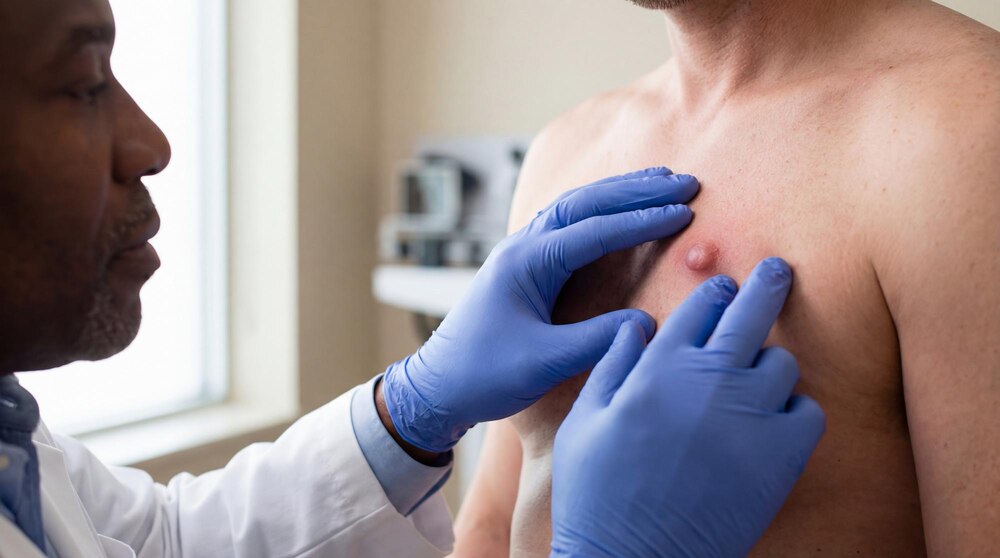
One-sided (unilateral) gynecomastia is the benign enlargement of glandular breast tissue affecting only one side of the male chest. Clinically, gynecomastia presents as a rubbery or firm mass extending concentrically from the nipple, according to endocrinologist Leonidas H. Duntas, MD. It differs from bilateral gynecomastia and from pseudogynecomastia, which is fatty tissue rather than gland.
True glandular gynecomastia involves a discrete, palpable mass beneath the nipple-areolar complex. When only one breast is affected, the chest appears visibly asymmetrical. Understanding this distinction matters because the firmness and central location of the tissue help separate ordinary gynecomastia from other conditions that require closer evaluation.
How Common Is Gynecomastia That Affects Only One Side?
Gynecomastia itself is extremely common. According to NIH Endotext data, physiologic gynecomastia affects 60-90% of newborns, 50-60% of pubertal boys, and 35-65% of men aged 50-69 years. Gynecomastia frequently begins asymmetrically, with one side enlarging first or remaining more prominent, even in cases that eventually become bilateral.
For this reason, one-sided onset is not unusual and does not, by itself, indicate something abnormal. Many men first notice a lump or fullness on a single side before any change appears on the other, making unilateral presentation a common entry point into evaluation.
How Is One-Sided Gynecomastia Different From a ‘Bigger Breast on One Side’?
A bigger breast on one side may stem from three distinct sources: true glandular gynecomastia, fatty pseudogynecomastia, or normal anatomical asymmetry. True gynecomastia involves a firm, rubbery gland under the nipple. Pseudogynecomastia is soft fat without a discrete mass. Normal asymmetry reflects minor size differences common across paired body structures.
Distinguishing these is the first step in treatment planning. Glandular tissue does not respond to weight loss, fatty tissue may shrink with diet and exercise, and mild natural asymmetry often requires no intervention at all. A physical examination usually identifies which category applies.
What Causes Gynecomastia on Only One Side?
One-sided gynecomastia shares the same underlying causes as bilateral disease, since hormonal imbalances are systemic. According to American Family Physician data, common causes include persistent pubertal gynecomastia (~25%), medications (10-25%), idiopathic cases (~25%), cirrhosis or malnutrition (8%), and hypogonadism. Differing tissue sensitivity can produce an asymmetric or one-sided response.
The table below summarizes the distribution of causes in men referred for gynecomastia evaluation.
| Cause | Approximate Frequency |
|---|---|
| Persistent pubertal gynecomastia | ~25% |
| Idiopathic (unknown) | ~25% |
| Medications | 10-25% |
| Cirrhosis or malnutrition | 8% |
| Primary hypogonadism | 8% |
| Testicular tumors | 3% |
| Secondary hypogonadism | 2% |
| Hyperthyroidism | 1.5% |
| Chronic renal insufficiency | 1% |
Can Puberty Cause Gynecomastia That Stays on One Side?
Yes. Pubertal gynecomastia is common, and roughly 25% of cases persist into adulthood, according to American Family Physician data. While most pubertal enlargement regresses within months to about two years, glandular tissue that remains beyond this window, sometimes on only one side, often becomes fibrotic and will not resolve on its own.
This explains a frequent concern among young men: unilateral enlargement that appeared during adolescence and never went away. Once the tissue matures and scars, conservative measures rarely change its size or firmness, which is why long-standing cases commonly require surgical correction for resolution.
Can Steroids or Medications Cause One-Sided Gynecomastia?
Yes. Anabolic steroids, certain prescription drugs, and hormonal medications can trigger gynecomastia, accounting for 10-25% of cases. A tender, firm lump beneath one nipple is a frequent early presentation, particularly among anabolic steroid users. The response may begin or remain more pronounced on one side before affecting both.
Medications commonly associated with gynecomastia include certain anti-androgens, some cardiovascular drugs, and agents that alter the testosterone-to-estrogen balance. Anyone who develops a new unilateral lump while using these substances should seek medical evaluation rather than attempting self-directed treatment, as proper assessment determines the cause and appropriate management.
Why Does One Side Remain Enlarged After Weight Loss?
After significant weight loss, fatty tissue shrinks but underlying glandular tissue does not. When a gland is present on one side, weight loss can make that side appear more prominent because the surrounding fat has reduced while the firm gland remains. This often reveals true gynecomastia that was previously masked.
This is a common source of frustration for men who lose weight expecting full chest flattening, only to find residual firmness or fullness on a single side. Because glandular tissue resists diet and exercise, this residual component typically requires surgical removal to achieve a flat, symmetrical contour.
Is One-Sided Gynecomastia a Sign of Male Breast Cancer?
Gynecomastia itself does not increase breast cancer risk, but a unilateral firm mass warrants evaluation to exclude malignancy. According to the American Cancer Society, approximately 2,790 men were expected to be diagnosed with invasive breast cancer in 2024, representing less than 1% of all breast cancers. Male breast cancer typically presents unilaterally in older men.
As the Memorial Sloan Kettering Cancer Center breast oncology team notes, gynecomastia “is the most common type of breast lump in men,” and “there is no evidence that gynecomastia increases a man’s risk for developing the disease.” The vast majority of one-sided lumps are benign, but because male breast cancer also presents on one side, evaluation provides reassurance and rules out rare malignancy.
What Are the Red-Flag Symptoms That Require Urgent Evaluation?
Certain features distinguish benign gynecomastia from concerning masses and warrant prompt medical attention. While most unilateral lumps are benign, the following warning signs should be evaluated without delay:
- A hard or irregular fixed mass, rather than a soft, rubbery central mass
- Nipple discharge, especially if bloody
- Nipple retraction or skin changes such as dimpling
- An eccentric (off-center) location away from the nipple
- Rapid growth of the mass
- Enlarged lymph nodes in the armpit
The presence of these symptoms does not confirm cancer, but it does signal the need for imaging and possible biopsy to reach a definitive diagnosis.
How Do Doctors Tell Benign Gynecomastia From Cancer?
Doctors distinguish benign gynecomastia from cancer primarily by the characteristics of the mass. According to breast radiologist Amy K. Patel, MD, benign gynecomastia typically presents as “a flat, rubbery, smooth, central breast mass,” while “male breast cancers are typically hard, irregular in shape.” Imaging and biopsy resolve any remaining uncertainty.
Dr. Patel, Medical Director of The Breast Care Center at Liberty Hospital and Assistant Professor of Radiology at the University of Missouri-Kansas City School of Medicine, notes that suspicious cases “typically undergo a diagnostic mammogram and some form of biopsy.” This structured approach ensures that the rare malignant case is identified while reassuring the many men whose findings are benign.
How Is Unilateral Gynecomastia Diagnosed?
Unilateral gynecomastia is diagnosed through a structured evaluation. According to endocrinologist Leonidas H. Duntas, MD, assessment “must include a detailed medical history, clinical examination, specific blood tests, imaging and tissue sampling.” This pathway identifies the underlying cause, distinguishes glandular from fatty tissue, and excludes malignancy when a firm one-sided mass is present.
The diagnostic process typically begins with a clinical breast examination and a review of medications, supplements, and medical history, followed by targeted testing based on the findings.
What Tests and Imaging Are Used (Ultrasound, Mammogram, Biopsy)?
Imaging selection depends on the patient’s age and the level of suspicion. Ultrasound is often the first-line imaging study for younger men, while diagnostic mammography is used when malignancy is a concern. As Dr. Duntas states, “mammography is the primary imaging method used when there is any suspicion of cancer.” Biopsy is performed when imaging findings are inconclusive or suspicious.
Peer-reviewed male breast imaging guidance from RSNA Radiographics supports this layered approach, combining clinical examination with ultrasound, mammography, and tissue sampling as indicated to reach an accurate diagnosis.
What Blood Tests Help Identify the Underlying Cause?
Blood tests help identify treatable hormonal and systemic causes of gynecomastia. A typical work-up includes testosterone, estradiol, luteinizing hormone (LH), human chorionic gonadotropin (hCG), thyroid function, and liver and kidney function tests. These results can reveal conditions such as hypogonadism, testicular tumors, hyperthyroidism, or cirrhosis.
Identifying an underlying cause is important because correcting it may halt progression and, in early cases, support partial regression. When laboratory results are normal and the gynecomastia is long-standing, the condition is often classified as idiopathic, and treatment focuses on the breast tissue itself.
Can One-Sided Gynecomastia Go Away on Its Own?
One-sided gynecomastia can resolve on its own in certain situations, but not all. Pubertal cases often regress within months to about two years. Drug- or steroid-induced cases may reverse if the cause is removed early, before fibrosis develops. Long-standing or fibrotic glandular tissue, however, typically does not resolve without surgery.
The key variable is time. Once glandular tissue becomes scarred and mature, the window for spontaneous or medical reversal closes, and the enlargement becomes permanent unless surgically removed.
Will Stopping Steroids or Changing Medication Reverse It?
Stopping steroids or changing a causative medication may reverse gynecomastia if done early, before the tissue becomes fibrotic. During the early, active phase, selective estrogen receptor modulators (SERMs) or aromatase inhibitors (AIs) prescribed under medical supervision can sometimes help. Once fibrosis sets in, however, the glandular enlargement generally becomes permanent.
This timing-dependent window is why medical guidance matters. Self-directed use of SERMs or AIs without proper evaluation carries risks, and a clinician can determine whether reversal is still possible or whether surgery is the more reliable solution for an established gland.
Can Diet and Exercise Fix Gynecomastia on One Side?
Diet and exercise cannot eliminate true glandular gynecomastia on one side. Weight loss reduces the fatty (pseudogynecomastia) component but has no effect on glandular tissue. In fact, losing fat around a persistent gland often makes the affected side appear more prominent, increasing visible asymmetry rather than resolving it.
For men whose asymmetry comes purely from fat, body composition changes may help. For those with a discrete gland, however, surgical removal remains the only reliable way to achieve a flat, balanced chest. Distinguishing fat from gland during evaluation clarifies which outcome to expect.
What Are the Treatment Options for One-Sided Gynecomastia?
Treatment options for one-sided gynecomastia fall into non-surgical and surgical categories. Non-surgical approaches include addressing the underlying cause, adjusting medications, and observation for recent-onset cases. Surgical treatment, the definitive solution for persistent or fibrotic tissue, combines liposuction to remove fat and direct gland excision to remove the firm glandular component.
The right choice depends on the cause, duration, and tissue type. Early hormonally driven cases may respond to medical management, while established glandular enlargement is best addressed surgically. A specialized evaluation determines the most appropriate path. Learn more about specialized treatment for unilateral gynecomastia and how individualized planning supports balanced results.
When Is Surgery Recommended for Unilateral Gynecomastia?
Surgery is recommended for unilateral gynecomastia when conservative measures have failed or are unlikely to help. Common indications include glandular tissue persisting beyond 12 months, long-standing fibrotic tissue, significant asymmetry affecting quality of life, and cosmetic correction following a benign cancer rule-out. The standard technique combines liposuction with gland excision.
In clinical practice, persistent one-sided glands that have matured rarely respond to anything other than surgery. When asymmetry is visible and stable, surgical correction offers a predictable, lasting result that diet, exercise, and medication cannot match.
Can You Get Surgery on Just One Side for Gynecomastia?
Yes, surgery can target only the affected side for gynecomastia. However, surgeons frequently evaluate both sides to ensure the corrected chest looks symmetrical. Operating on a single side is appropriate when the opposite side is genuinely normal, but achieving balance sometimes requires minor refinement of the unaffected side as well.
This decision is individualized. The goal is a natural, balanced chest contour, so the surgical plan is built around how the two sides compare in volume, gland presence, and skin quality rather than a fixed rule about operating on one side versus both.
How Do Surgeons Achieve Symmetry Between Both Sides?
Surgeons achieve symmetry by contouring the affected side to match the unaffected side, or by making minor adjustments to both sides for balanced results. Gland excision removes the firm component, while liposuction blends the surrounding tissue for a smooth transition. Comparing both sides during surgery ensures the final contour appears natural and even.
For example, if one side carries a prominent gland and the other has slight fullness, the surgeon may remove the gland on the affected side and perform light liposuction on the other to harmonize the two. This symmetry-focused approach is central to a satisfactory cosmetic outcome.
Will Scarring Differ Between One Side and Both Sides?
Scarring depends on the technique used rather than the number of sides treated. Gland excision typically uses a small periareolar incision at the edge of the areola, while liposuction requires only tiny access points. Operating on both sides may produce matching incisions, which can actually help the chest appear more balanced.
Skilled placement keeps scars discreet and well-camouflaged. When only one side is operated on, the surgeon weighs whether a matching incision on the other side would improve overall symmetry, factoring scar appearance into the broader goal of a uniform result.
What Does Recovery From One-Sided Gynecomastia Surgery Involve?
Recovery from one-sided gynecomastia surgery typically follows an outpatient procedure performed under general anesthesia. Patients wear a compression garment to control swelling, return to desk work within several days to a week, and resume strenuous exercise after a few weeks. Swelling resolves gradually, with final symmetry visible over the following months.
Planning ahead matters for those hoping to be confident by summer. Because final results settle over several months, men who want a comfortable beach or pool season often schedule their procedure well in advance. Following post-operative instructions, particularly garment use and activity limits, supports the smoothest recovery and the most balanced outcome.
Does Insurance Cover Surgery for Unilateral Gynecomastia?
Insurance coverage for unilateral gynecomastia surgery varies by policy and depends on medical necessity. Documented pain, a persistent mass, or surgery performed as part of a cancer rule-out may support a medical-necessity argument. Purely cosmetic correction of asymmetry, however, is typically considered elective and paid out of pocket.
Because policies differ, thorough documentation is essential. Records of symptoms, imaging, examination findings, and failed conservative treatment strengthen any coverage request. Patients should confirm specific requirements directly with their insurer before scheduling, as approval criteria are determined on a case-by-case basis.
Frequently Asked Questions About One-Sided Gynecomastia
The questions below address common long-tail concerns about unilateral gynecomastia, drawn from frequent patient and community inquiries. Each answer is concise and self-contained for quick reference.
Is It Normal to Develop Gynecomastia on Only the Left Side?
Yes, it is normal for gynecomastia to develop on only the left side, or only the right side. Either breast can be affected, and the specific side involved does not independently indicate malignancy. What matters is the character of the mass, not which side it appears on. A firm, irregular, or changing mass on any side warrants evaluation.
How Much Does Unilateral Gynecomastia Surgery Cost?
The cost of unilateral gynecomastia surgery depends on the technique used, the extent of tissue removed, anesthesia, and the surgeon’s experience. Because each case is unique, fixed pricing is not meaningful. A personalized quote following an in-person consultation provides the most accurate estimate based on your specific anatomy and surgical plan.
Can One-Sided Gynecomastia Come Back After Surgery?
Recurrence after complete gland excision is uncommon. However, resuming causative drugs or anabolic steroids, or significant weight gain, can affect long-term results. Removing the gland addresses the existing tissue, but addressing the underlying cause is essential to preserving the outcome. Maintaining a stable weight and avoiding triggering substances supports lasting results.
When Should I See a Doctor About a One-Sided Breast Lump?
You should see a doctor promptly about any new, firm, or changing one-sided breast lump. While most such lumps are benign gynecomastia, evaluation rules out rare malignancy and identifies treatable causes such as medication effects or hormonal imbalances. Early assessment provides reassurance and, when needed, opens a wider range of treatment options.
How Can Boston Gyno Help With One-Sided Gynecomastia?
Boston Gyno focuses specifically on gynecomastia, including the diagnostic and surgical challenges of asymmetric and unilateral cases. The center’s symmetry-focused surgical approach combines liposuction and gland excision to deliver balanced, natural chest contours, with both sides carefully assessed to ensure an even result.
This specialized concentration on male chest contouring means each plan is tailored to the patient’s anatomy, cause, and goals. Men who want to understand their options can review one-sided gynecomastia and unilateral breast enlargement in men in greater detail before scheduling. With summer underway, now is a practical time to begin the evaluation process so results can settle ahead of next season. Scheduling a consultation is the first step toward an accurate diagnosis and a confident, balanced outcome.
One-sided gynecomastia is common, usually benign, and highly treatable. A firm unilateral mass deserves evaluation to exclude rare malignancy, but most cases stem from hormonal, pubertal, medication, or weight-related causes. When glandular tissue persists, surgery combining liposuction and gland excision offers a reliable, symmetrical result, restoring both chest contour and confidence.
Frequently Asked Questions
Can gynecomastia occur in only one breast?
Yes, gynecomastia commonly affects only one breast. Unilateral gynecomastia is the benign enlargement of glandular tissue on a single side of the male chest. Gynecomastia frequently begins asymmetrically, with one side enlarging first or remaining more prominent, even in cases that eventually become bilateral. One-sided onset is common and does not, by itself, indicate anything abnormal.
Is one-sided gynecomastia a sign of male breast cancer?
One-sided gynecomastia itself does not increase breast cancer risk, but a unilateral firm mass warrants evaluation to exclude malignancy. According to the American Cancer Society, about 2,790 men were expected to be diagnosed with invasive breast cancer in 2024, under 1% of all breast cases. The vast majority of one-sided lumps are benign, but evaluation rules out rare cancer.
How long does it take for one-sided gynecomastia to go away on its own?
Pubertal gynecomastia often regresses within months to about two years. Drug- or steroid-induced cases may reverse if the cause is removed early, before fibrosis develops. However, long-standing or fibrotic glandular tissue typically does not resolve without surgery. Once glandular tissue becomes scarred and mature, the window for spontaneous or medical reversal closes and the enlargement becomes permanent.
Can diet and exercise fix gynecomastia on one side?
Diet and exercise cannot eliminate true glandular gynecomastia on one side. Weight loss reduces the fatty (pseudogynecomastia) component but has no effect on glandular tissue. In fact, losing fat around a persistent gland often makes the affected side appear more prominent, increasing visible asymmetry. For a discrete gland, surgical removal remains the only reliable way to achieve a flat, balanced chest.
Can you get gynecomastia surgery on just one side?
Yes, surgery can target only the affected side for gynecomastia. However, surgeons frequently evaluate both sides to ensure the corrected chest looks symmetrical. Operating on a single side is appropriate when the opposite side is genuinely normal, but achieving balance sometimes requires minor refinement of the unaffected side. The goal is a natural, balanced chest contour.
What does recovery from one-sided gynecomastia surgery involve?
Recovery typically follows an outpatient procedure performed under general anesthesia. Patients wear a compression garment to control swelling, return to desk work within several days to a week, and resume strenuous exercise after a few weeks. Swelling resolves gradually, with final symmetry visible over the following months. Following garment use and activity limits supports the smoothest recovery.
Does insurance cover surgery for unilateral gynecomastia?
Insurance coverage for unilateral gynecomastia surgery varies by policy and depends on medical necessity. Documented pain, a persistent mass, or surgery performed as part of a cancer rule-out may support a medical-necessity argument. Purely cosmetic correction of asymmetry is typically considered elective and paid out of pocket. Patients should confirm specific requirements directly with their insurer before scheduling.



